Schools of Neidan
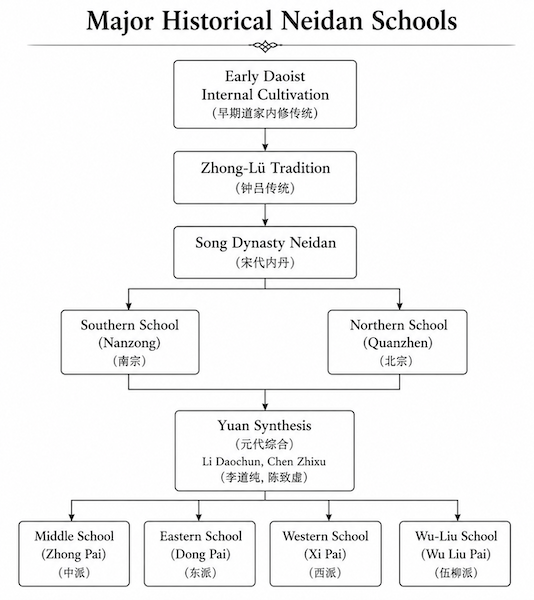
Neidan 内丹 (“inner alchemy”)–a (mostly) Daoist tradition of meditation and internal cultivation, has a long and complex history which cannot be adequately represented as a simple succession of neatly bounded schools. The Northern and Southern lineages were the two major formations emerging between the 11th and 13th centuries. These categorizations were not so much labels officially recognized by the representative figures of those times, but rather labels applied retrospectively as a convenient way to classify major currents within neidan.
This article does not attempt to be comprehensive or definitively correct. It is intended more as a set of notes but with the intention of bringing more awareness to the greater context of the neidan tradition.
Within the western internal arts scene, there is a general lack of knowledge of the broader context and history of neidan and its lineages (not to mention confusion over what distinguishes neidan from qigong/neigong). Often times weight is heavily based on famous contemporary masters and/or popular books which may grant celebrity status to what are sometimes small and obscure lineages, meanwhile ignoring others which may have vastly greater historical significance.
This article serves merely as a set of notes to hopefully spark curiosity and further research.
| Neidan School | Principal period | Representative figure(s) |
|---|---|---|
| Southern Lineage 南宗 | 11th–13th centuries | Zhang Boduan, Chen Nan, Bai Yuchan |
| Northern Lineage 北宗 | 12th century onward | Wang Chongyang, Seven Perfected |
| Central School 中派 | Late 13th century teachings; label later | Li Daochun |
| Eastern School 東派 | 16th century onward | Lu Xixing |
| Western School 西派 | 19th century onward | Li Xiyue |
| Wu-Liu School 伍柳派 | 17th–18th centuries onward | Wu Shouyang, Liu Huayang |
| Sanfeng traditions 三豐派 | Mainly Ming–Qing textual formation | Zhang Sanfeng; later editors and recipients |
Southern Tradition 南宗
Historical formation
The Southern Lineage, Nanzong 南宗, centers on the teachings associated with Zhang Boduan 張伯端, traditionally dated 987–1082, author of the Wuzhen pian 悟真篇, Awakening to Reality. Its standard succession of masters is:
- Zhang Boduan 張伯端
- Shi Tai 石泰
- Xue Daoguang 薛道光
- Chen Nan 陳楠
- Bai Yuchan 白玉蟾
These figures became known as the “Five Patriarchs of the Southern Lineage.” The genealogy was constructed and consolidated by later disciples, especially around Bai Yuchan and his followers, and so the identity of “Southern Lineage” was not something that existed at the time in the modern institutional sense.
Key characteristics
The Southern Lineage is conventionally described as giving initial priority to ming 命, “life-destiny” or “life-energy”, the embodied or vital basis of life, before completing the cultivation of xing 性, “innate nature.” This is often summarized as:
先命後性
Cultivate Ming first, and Xing afterward.
This does not mean that Southern masters neglected xing. Both Northern and Southern traditions advocated the joint cultivation of xing and ming, but they differed in emphasis and sequencing. The style of the Southern School just places a lot of refining essence (jing) and transforming qi at first.
Typical features include:
- Strong use of the symbolic vocabulary of the Cantong qi 參同契 and external alchemy.
- The conjunction of true Yin and true Yang.
- Detailed discussion of the medicines, furnace, tripod, fire phases, and stages of alchemical transformation.
- In several later Southern texts, integration with ritual Daoism, thunder rites, and divine revelation.
Bai Yuchan, in particular, was not merely a master of meditation, but was also involved in Daoist ritual traditions and helped transform the Southern current into a broader religious formation.
Some of the Major Texts
The most important texts include:
- Zhang Boduan, Wuzhen pian 悟真篇
- Shi Tai, Huanyuan pian 還源篇
- Xue Daoguang, Fuming pian 復命篇
- Chen Nan, works collected under titles such as Cuixu pian 翠虛篇
- Bai Yuchan, Zhiming pian 指玄篇 Ziqing Zhixuan Ji 紫清指玄集, and others
- Jindan dacheng ji 金丹大成集, associated with Bai Yuchan’s transmission
Although technically earlier, Cantong Qi 參同契 by Wei Boyang was frequently quoted in Southern texts. It should be noted that early texts which make up the classical neidan canon such as the Cantong Qi, Zhong-Lü chuandao ji 鍾呂傳道集, Yinfu Jing 陰符經, Ruyao Jing 入藥鏡, etc do not descend from any particular neidan school, but rather could be considered a part of a shared, foundational canon that were important to all of the schools.
Northern Tradition 北宗
Historical formation
The Northern Lineage, Beizong 北宗, is closely identified with the early Quanzhen 全真 movement founded by Wang Chongyang 王重陽 in the twelfth century.
Its most famous early masters are Wang Chongyang and his principal disciples, conventionally called the Seven Perfected 七真 “Qi Zhen” of Quanzhen:
- Ma Yu 馬鈺
- Tan Chuduan 譚處端
- Liu Chuxuan 劉處玄
- Qiu Chuji 丘處機
- Wang Chuyi 王處一
- Hao Datong 郝大通
- Sun Bu’er 孫不二
Quanzhen became a large, organized Daoist religious movement with monastic institutions, clerical ordination, communal discipline, temples, and lineage networks with Longmen today being by far the dominant branch.
Key characteristics
The Northern tradition is conventionally described as placing initial emphasis on “innate nature” xing 性—purification of mind/conscioussness, and freedom from attachments—before the full transformation of “life-energy” ming 命. This is often summarized as:
先性後命
Cultivate Xing first, and Ming afterward.
Again, this is a relative emphasis. Quanzhen ultimately strongly supports the dual cultivation of xing and ming, and did not reject bodily or energetic cultivation. Its writings discuss qi, spirit (shen), the Elixir, the mysterious pass, and the transformation of the body, but they place especially strong emphasis on moral discipline, celibacy, mental purification, simplicity, and meditative stillness.
Important characteristics include:
- Ascetic discipline and reduction of desires.
- Celibacy among committed monastics.
- Meditation, clarity and stillness 清静.
- Integration of Daoist, Chan Buddhist, and Confucian language and emphasis on the unity of the Three Teachings (Daoism, Buddhism, Confucianism).
- Communal religious identity and eventually monastic organization.
Wang Chongyang’s writings repeatedly insist that the Elixir is not a crude physical substance and that genuine cultivation depends on purification of the heart-mind.
Some of the Major texts
- Wang Chongyang, Fifteen Discourses on Establishing the Teaching Chongyang lijiao shiwu lun 重陽立教十五論
- Poetry and instructional writings of Wang Chongyang
- Works of Ma Yu and Qiu Chuji
- Dadan zhizhi 大丹直指, traditionally associated with Qiu Chuji
- Longmen Classics
- Wang Changyue, Longmen Xinfa 龍門心法
- Min Yide, 古書隱樓藏書 (compilation)
- Works and commentaries by Liu Yiming
- Canonical Scriptures including Scripture of Clarity and Stillness Qing Jing Jing 清靜經, Hidden Talisman Scripture Yin Fu Jing 陰符經, Dao De Jing 道德經
- Later influential texts: The Secret of the Golden Flower Taiyi Jinhua Zongzhi 太乙金華宗旨
The convergence of Northern and Southern traditions
The Northern and Southern schools of neidan did not remain permanently opposed. By the late thirteenth and fourteenth centuries leading figures in the neidan community had begun synthesizing their teachings.
Two leading figures were:
- Li Daochun 李道純
- Chen Zhixu 陳致虛
Pregadio identifies Li Daochun’s Zhonghe ji 中和集 and Chen Zhixu’s Jindan dayao 金丹大要 as major witnesses to the integration of Northern and Southern traditions.
This synthesis is essential for understanding the later schools. Eastern, Western, Middle, and Wu-Liu teachings did not develop from isolated and mutually exclusive bodies of doctrine. They inherited a neidan discourse that had already absorbed materials from multiple lineages.
Middle School 中派
Historical identity
The “Middle School” also called “Central School” Zhongpai 中派, is primarily associated with Li Daochun 李道純, active in the late thirteenth century. His famous anthology was:
Zhonghe ji 中和集
Anthology of Central Harmony
However, the designation “Middle School” was attached to Li Daochun’s teachings retrospectively, especially from approximately the eighteenth century onward. There is little evidence that Li himself founded a formally organized school called Zhongpai. His disciple Cai Zhiyi 蔡志頤 compiled or transmitted the materials forming the Zhonghe ji.
The highly influential Qing Dynasty master Huang Yuanji 黄元吉 also became associated with the Middle School.
Key characteristics
The term “central” is doctrinally appropriate because Li Daochun repeatedly emphasizes:
- The center 中.
- Harmony 和.
- The unification of xing and ming.
- Avoidance of one-sided approaches.
- Integration of Northern and Southern teachings.
- The mysterious pass, xuanguan 玄關, as transcending fixed bodily localization.
- Inner realization as the basis for correctly understanding alchemical terminology.
The idea of Xing and Ming dual cultivation involving the “single opening of the mysterious barrier” is used to access pre-heaven qi is crucial to the Middle School approach, which combines Northern and Southern School approaches.
He drews upon:
- The Daode jing.
- The Cantong qi.
- The Wuzhen pian.
- Quanzhen teachings.
- Chan Buddhist language.
- The conceptual framework of xing and ming.
Eastern School 東派
Historical identity
The Eastern School, Dongpai 東派, is associated primarily with the Ming author Lu Xixing 陸西星, also known as Lu Qianxu 陸潛虛, who lived during the sixteenth century.
Lu claimed revelatory or spiritual transmission from Lü Dongbin 呂洞賓. He was an important editor, commentator, and author of neidan literature. The designation “Eastern School” was applied to the current built around his teachings.
Key characteristics
The Eastern School starts with the cultivation of ming 命, similar to the Southern School. Lu Xixing is frequently associated with yin-yang paired cultivation, 陰陽雙修, or methods involving a male and female practitioner. although this is controversial. Some writings connected with Lu’s tradition use sexual or paired-cultivation language literally, while other passages can be read symbolically or as combining physical and internal interpretations.
Key features include:
- Strong devotion to Lü Dongbin as revealer and patriarch.
- Interest in spirit-writing and revealed instruction.
- Reinterpretation of classical Neidan through late-Ming religious culture.
- Detailed discussion of Yin and Yang conjunction.
Some of the Major texts
Lu Xixing’s works are commonly gathered under titles such as:
- Fanghu waishi 方壺外史
- Commentaries and writings attributed to his transmission from Lü Dongbin
- Collections relating to Neidan, spirit-writing, and paired cultivation
Western School 西派
Historical identity
The Western School, Xipai 西派, was created around the teachings of Li Xiyue 李西月, also known as Li Hanxu 李涵虛, 1806–1856, a Qing-period Neidan master from Sichuan.
Li claimed visionary transmission from Lü Dongbin and Zhang Sanfeng. He edited the influential Zhang Sanfeng quanji 張三豐全集, Complete Collection of Zhang Sanfeng, in 1844. Pregadio describes Li Xiyue as the founder of the so-called Western Branch of late Neidan.
The term “Western” probably relates partly to Li’s geographical location in Sichuan, west of the regions associated with Lu Xixing’s Eastern current, but it also became a lineage identity for his teachings and successors.
Key characteristics
The Western School presents itself as a synthesis of major Neidan traditions, particularly those associated with Lü Dongbin and Zhang Sanfeng.
Its characteristic themes include:
- Joint cultivation of xing and ming.
- The mysterious pass, xuanguan yiqiao 玄關一竅.
- Entering obscurity or profound darkness, often described through terms such as zuan yaoming 鑽杳冥.
Some of the Major texts
- Li Xiyue, writings collected in Western-lineage compilations
- Zhang Sanfeng quanji 張三豐全集, edited by Li Xiyue
- Works concerning the Daoist “subtle doctrines” of the Western tradition
- Later Western-lineage commentaries and instructional collections
Wu-Liu School 伍柳派
Historical identity
The Wu-Liu School is named for:
- Wu Shouyang 伍守陽, also called Wu Chongxu 伍沖虛, approximately 1574–1644
- Liu Huayang 柳華陽, eighteenth century
Unlike “Eastern” or “Central,” Wu-Liu refers quite directly to a recognizable textual and teaching tradition formed around the writings of these two authors. Wu-Liu is said to have originated from the Quanzhen Longmen lineage, although its neidan should not be seen as merely a variant of Longmen neidan.
Key characteristics
Wu-Liu teaching is noted for:
- Qingjing 清靜, clarity and stillness.
- Joint cultivation of xing and ming.
- Detailed physiological and energetic explanations.
- Strong emphasis on the precelestial true qi or true Yang.
- Precise descriptions of the medicine, firing process, circulation, embryonic breathing, and formation of the immortal embryo.
- Integration of Daoist alchemy with Buddhist terminology.
- The ideal of xianfo hezong 仙佛合宗, “uniting the traditions of immortality and Buddhahood.”
Wu-Liu texts are more explicit and procedural than many earlier Neidan classics. They explain technical terminology at length and often present the path as an ordered sequence of experiential stages.
Some of the Major texts
Wu Shouyang:
- Tianxian zhengli zhilun 天仙正理直論
- Xianfo hezong yulu 仙佛合宗語錄
Liu Huayang:
- Jinxian zhenglun 金仙證論
- Huiming jing 慧命經
Later collections commonly gather these works under the title:
Wu-Liu xianzong 伍柳仙宗
Immortal Tradition of Wu and Liu
Zhang Sanfeng tradition 三豐派
Zhang Sanfeng is a semilegendary immortal whose historical identity is difficult to establish. Materials attributed to him span widely separated periods, and many were written or compiled long after the era in which he was supposedly active.
The Zhang Sanfeng quanji was edited by Li Xiyue in 1844, making the Western School instrumental in shaping the received image of Zhang Sanfeng as a Neidan patriarch.
Accordingly, “Zhang Sanfeng School” may refer to several overlapping things:
- Neidan writings attributed to Zhang Sanfeng.
- Qing-period groups claiming revelation or transmission from him.
- Wudang-based Daoist traditions that adopted him as patriarch.
- The Western School’s construction of a Zhang Sanfeng corpus.
- Modern martial and Daoist lineages identifying him as founder.
Key characteristics
The received Zhang Sanfeng corpus often emphasizes:
- Joint cultivation of xing and ming (with perhaps a little more emphasis on ming).
- The mysterious pass.
- Return to precelestial unity.
- Conjunction of Yin and Yang.
Some of the Major texts
- Zhang Sanfeng quanji 張三豐全集
- Sanfeng danjue 三豐丹訣
- Various poems, instructions, and commentaries attributed to Zhang Sanfeng
- Later Wudang and Western-lineage collections
Daoist Lineages
While the above discussion can be seen as tracing “lineages” in the sense of broad schools, styles, or “currents” of neidan through its historical development, the concept of “lineage” as in “lineage transmission” is more concerned with who inherited a teaching from whom and the specific groups associated with that.
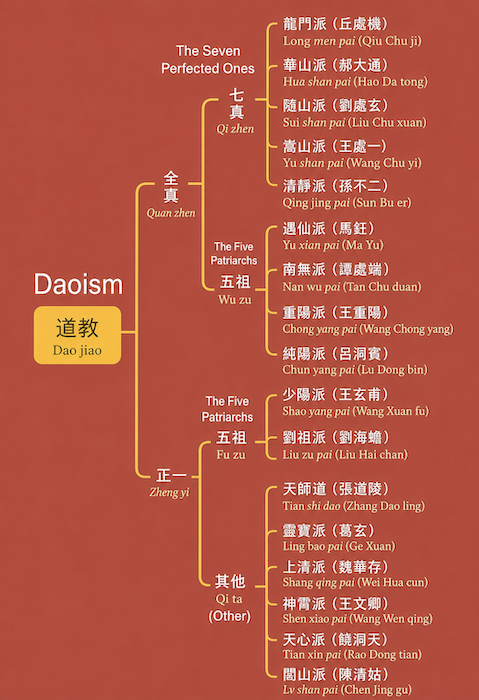
The two overarching lineages within Daoism are Quanzhen and Zheng Yi, and within those are many sub-lineages. Below is a graphic circulating on Chinese internet that lists some well-known lineages with English and pinyin added. This is of course not complete, as there are many more well-known and of course countless lesser-known, small lineages.