Buddhism
-
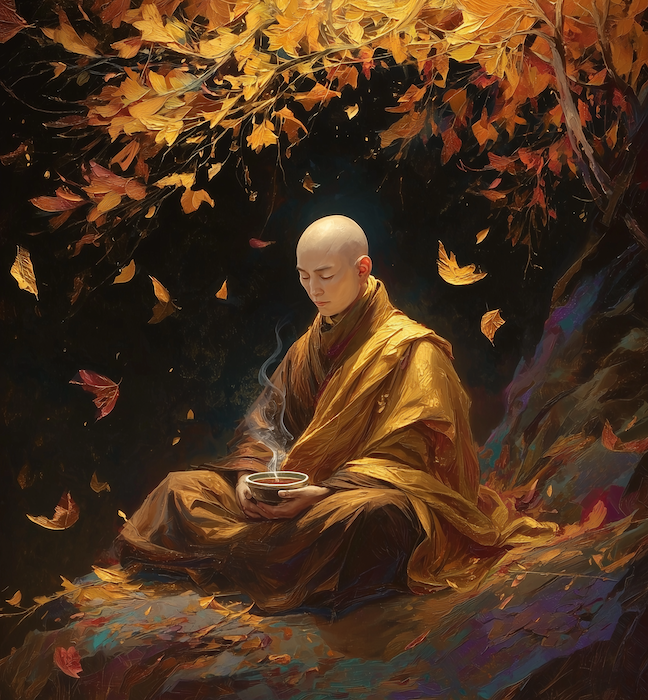
Tea and Zen, One Taste 禅茶一味
The famous saying Chan cha yi wei 禅茶一味 means that tea and Zen are the same (lit. Zen and tea, one taste). This illustrates the fact that Zen practice is not bound to the meditation cushion, but should necessarily be integrated into daily life: “meditation in action.” The tea ceremony can then become a vehicle for practicing Zen. The character for Zen in Chinese is Chan 禅 (禪). “Chan” is a transliteration of the Sanskrit word dhyana (jhana) which is a form of meditation that involves profound concentration and deep absorption on a singular object of meditation. The word can be broken down into dhi (mind) + yana (vehicle). The…
-
“Eating Bitter” 吃苦 in Kneeling Posture 跪坐
Chan Cha 禅茶 (Tea and Zen) practice at Wenshu Monastery advocates a kneeling posture (gui zuo 跪坐) for tea practice. This is a seated posture that can quickly become intense and uncomfortable as the legs quickly become numb. This is a form of “eating bitter” 吃苦. From a Buddhist perspective, this disciplines the practitioner and reminds them that suffering is a part of living in the world. Continue reading (members only)…
-
Fagong 发功: Significance and Historical Evidence
Fagong 发功, the skill of emitting qi, is a diverse topic as it actually has quite a long history in China, there are many types of qi emission, and there are various reasons why this skill might be something to pursue. Historical Evidence of Qi Emission Qi emission, or faqi 发气, can be a controversial subject and, for the most part, in China has been taboo to demonstrate or speak of too publicly since well before the internet was around. So although it is something that exists among neigong adepts in China, you won’t find demonstrations or much about it on Chinese internet or social media. Interestingly, records of qi…
-
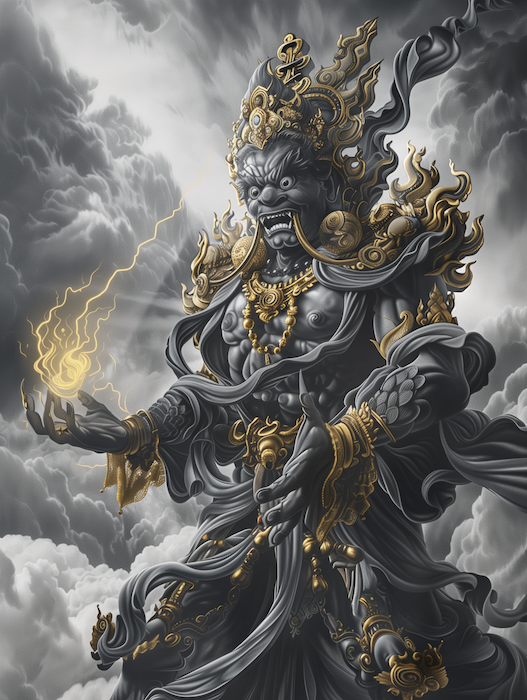
Vajrapani: the Protector of Shaolin
Vajrapani is a deity with special significance for Shaolin Temple who is rich with symbolism. Could he also represent the skill of electric-like qi emission? As discussed below, this idea may not be too much of a stretch. Vajrapani is the patron Bodhisattva and protector deity of Shaolin Temple. In Chinese he is called Jingang Shou Pusa (金刚手菩萨), literally, “holder of the vajra.” The vajra is both a symbolic ritual object and a weapon, and could be translated from Sanskrit as either “thunderbolt” or “diamond.” Vajrapani is a deity that is not only seen as a protector and source of strength, but also represents some of the most interesting juxtapositions…