The Celestial Eye 天目
There is a lot of interest online surrounding the third eye and “opening the third eye.” Although perhaps there are many misunderstandings as well. Many ideas are based on modern conceptions which may or may not be rooted in authentic systems of spiritual cultivation.
The Chinese traditions of internal cultivation have been refined over many centuries. So one might wonder how this idea of opening the third eye is discussed in centuries-old traditions like Daoist internal alchemy (neidan).
It could be said that in neidan, the third-eye (tianmu) and other related energetic anatomy of the head first become active when a practitioner’s meditation practice has become deep enough that they begin to experience the initial signs of the opening of the so-called Single Opening of the Mysterious Barrier (xuanguan yiqiao 玄关一窍). This is essentially the entry point into the pre-heaven state of consciousness in which all of the true inner alchemical work gets done.
Initially, once the practitioner has accessed pre-heaven qi and it begins to circulate, it activates the upper dantian (generally considered to be directly connected to or a part of the celestial eye) and is experienced as flashes of white or golden shenguang 神光 (spirit light). Various manifestations of inner light occur at different stages of the inner alchemical process, and could themselves be considered as a sort of “opening” of the third-eye. At yet more advanced stages, the practitioner may begin to perceive their internal organs during meditation.
Often, what is colloquially referred to as “opening the third eye” relates to the attainment of extrasensory perception such as clairvoyance, telepathy, visions, and the ability to see non-physical entities such as ghosts. This is a vast topic within the Daoist tradition, but for the purposes of this article we can say that these abilities generally correspond to what are called the Six Spiritual Powers (liu shentong 六神通), especially the Power of the Celestial Eye (tianyan tong 天眼通), which will be discussed further below. So as we can already see, there can be multiple meanings and phases to “opening the third eye.”
HIstorical Accounts
The term tianmu 天目, as it’s called in Chinese, often translated as “celestial eye,” does not appear to exist in many neidan texts until rather late in the history of the tradition. One version of the famous Qing Dynasty text The Secret of the Golden Flower (Taiyi Jinhua Zongzhi 太乙金華宗旨) mentions it:
眉心即天目,乃為三光會歸出入之總戶。
“The center of the brows is the Celestial Eye; it is the general gateway through which the three lights gather, return, enter, and emerge.”
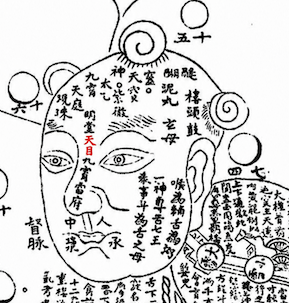
We can see that at least some versions of the famous inner alchemy chart called the Xiuzhen Tu have the characters tianmu 天目 inscribed between the eyes:
There are perhaps older references in the Daoist Canon, such as the in Song-Yuan thunder-rite material compiled in the Daofa Huiyuan 道法会元.
The celestial eye is often associated with the point between the eyebrows (the yintang point), however it can also refer to a larger region depending on lineage and context. For example, the entire region that sits within the horizontal line starting at the point between the brows and going through the head to the back of the head (including the upper dantian), can also be considered the celestial eye.
Tianyan tong 天眼通, the “Power of the Celestial Eye,” is traditionally counted among the so-called Six Spiritual Powers (liu shentong 六神通, or simply liutong 六通). This sixfold scheme originated in Buddhism, where it is known in Sanskrit as the ṣaḍabhijñā, or “six higher knowledges.” Comparable abilities were described individually in early neidan literature, while the complete sixfold scheme probably entered neidan during the early Quanzhen period and is certainly present in Yuan Dynasty texts, as the tradition increasingly synthesized Daoist and Buddhist concepts.
Six Spiritual Powers
The Six Spiritual Powers (aka Six Spirit Pervasions liu shentong 六神通) are listings of the common siddhis that arise as a result of advanced attainments in practice.
Below are two examples of listings of the Six Spirit Powers/Pervasions.
Several of these abilities, including “celestial vision,” may be understood in modern discourse as manifestations of what is commonly called an “open third eye.”
The majority of these arise sometime during or at the end of the refining qi into shen stage of inner alchemy. So, in other words, the practitioner has likely already attained the status of an Earth Immortal and is well on their way to (or already) attaining Spirit Immortal status. This is a significant achievement that is not easily attained! The initial foundation building stage and the refining jing into qi stages have necessarily already been completed at this point–likely taking years of very dedicated practice. The practitioner has long committed to a lifestyle highly devoted to meditation practice and the cultivation of virtue, lengthy daily meditation sessions (likely several hours per session), and perhaps several serious meditation retreats per year.
Importantly, it should always be pointed out that these powers are not the goal of practice, but rather signs of successful practice.
This first example is from the Lun Liutong Jue (Instructions on the Six Pervasions), a Yuan dynasty internal alchemy text1.
- Pervasion of Heart-mind Conditions, involving the ability to experience unified nature as distinct from the ordinary body.
- Pervasion of Spirit Conditions, involving the ability to know things beyond ordinary perception.
- Pervasion of Celestial Vision, involving the ability to perceive internal landscapes within the body.
- Pervasion of Celestial Hearing, involving the ability to hear the subtle communications of spirits and humans.
- Pervasion of Past Occurrences, involving the ability to understand the karmic causes and effects relating to the Three Realms of desire, form, and formlessness.
- Pervasion of the Heart-minds of Others, involving the ability to manifest the body-beyond-the-body.
This second example is based on the Wu-Liu corpus2.
- Power of celestial eyes (tianyan tong 天眼通)
- Power of celestial ears (tianer tong 天耳通)
- Power of past lives (suming tong 宿命通)
- Power of the minds of others (taxin tong 他心通)
- Power of the conditions of shen (shenjing tong 神境通)
- Power of terminated outflow (loujin tong 漏盡通)
Daoist Energetic Anatomy Within the Head
Daoists extensively mapped the body’s energetic anatomy, including a complex network of interconnected centers within the head that are often associated with, or collectively all considered a part of the Celestial Eye.
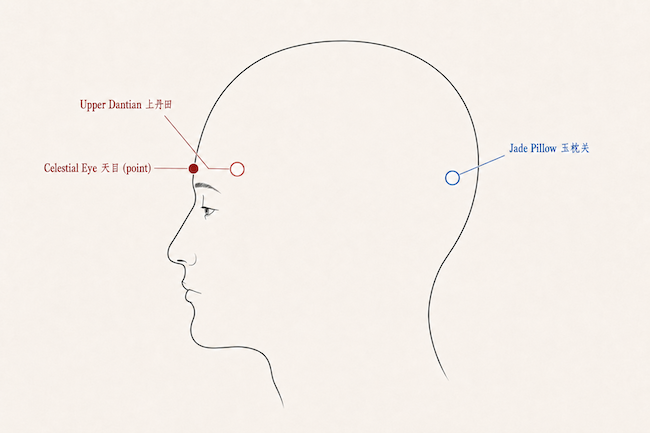
Some of the most common and important points are the point directly between the eyebrows (referred to as the yintang point in modern acupuncture), the upper dantian (aka Niwan), and the Jade Pillow barrier at the back of the head–the three are situated on a horizontal line running through the head from front to back. There are many other important points on and in the head as well as on this horizontal “celestial eye” line (we will look at a couple of examples from specific lineages in the “members only” section of the article), but a very basic diagram is included below.
The Dadan Zhizhi 大丹直指 (“Direct Instructions on the Great Elixir”) an important Quanzhen inner-alchemy manual traditionally attributed to Longmen founder Qiu Chuji 丘处机 (1148–1227) highlights these three basic points:
再论三田:泥丸谓之上丹田,其穴在两眉正中入内三寸之地,方圆一寸二分,虚间一穴,乃藏神之所。
Next, concerning the Three Fields: the Niwan is called the Upper Dantian. Its cavity is situated three cun inward from the exact center between the eyebrows. Measuring one cun and two fen across, it contains an empty cavity and is the place where spirit is stored.
又上至脑后,谓之玉枕关。三关通起一条髓路,号曰漕溪,又曰黄河,乃阳气上升之路。
Ascending farther to the back of the head is the Jade Pillow Pass. The three passes are connected by a single pathway through the marrow, called the Cao Stream or Yellow River; it is the route by which yang qi ascends.
References
1. Komjathy, L., 2014: Daoism: A Guide for the Perplexed. Bloomsbury. 7, 117-145.
2. Enckevort, P., 2014: The Three Treasures: An Enquiry into the Writings of Wu Shouyang. Journal of Daoist Studies.

