
Medicinal Herbs and Energetic Adjustments as Support for Practice
Medicinal herbs have been used as support for Chinese internal cultivation practices for centuries. In his famous Fifteen Discourses to Establish the Teachings, which are essentially guidelines on the fundamentals of cultivation, founder of the Northern School of Daoist Alchemy, Wang Chongyang has an entire discourse dedicated to medicinal herbs.
藥者,乃山川之秀氣,草木之精華
Medicinal herbs are the flourishing emanations of mountains and waterways, the essential florescence of plants and trees…
…If one is willing to study them as essences, one can enliven the Xing (innate nature) and Ming (life-destiny) of people…
…If you do not understand herbal preparation, you will have no way to support the Dao.1
Today, herbal support can take many forms. Gentle herbs and medicinal foods can be incorporated into the daily diet, while practitioners may consult a qualified Chinese medicine practitioner for formulas tailored to their individual needs. At the more specialized end of the spectrum, some internal-cultivation lineages preserve special herbal formulas that have been passed down through generations.
Many have experienced profound results when the application of powerful qi emission therapy has been combined with these special pills. This is essentially the high-end of classical Chinese medicine though, and the pills can be quite expensive, so it’s not for everyone.
China has a long tradition of preparing special pills or dan which can involve the progressive refinement of many rare and high-quality ingredients in a labor-intensive process over long periods of time.
It is no secret that certain rare ingredients used in Chinese medicine such as wild ginseng, cordyceps, fenzao, and musk can come with very high price tags–even just for individual ingredients.
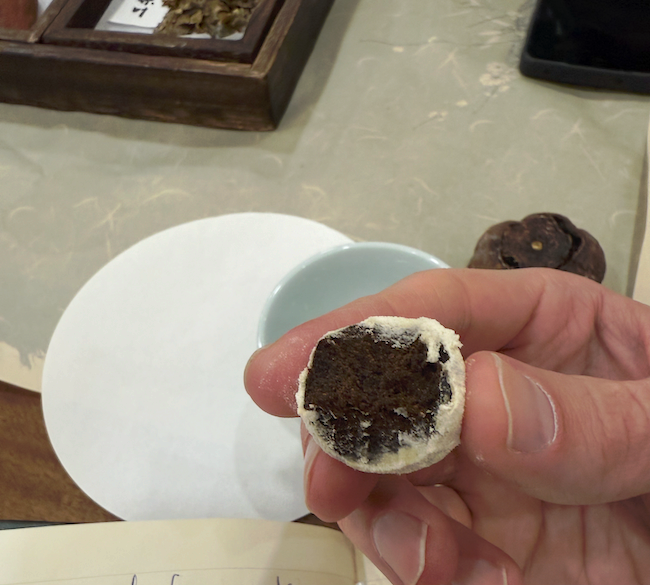
Take this special pill called a baizi wan that was gifted to me by a senior monk at a Buddhist monastery. It has 108 herbal ingredients and its processing took an entire year during which it had to be carefully observed and attended to each day.
The huaxue dan used by some of the masters that I study under can have remarkable results for resolving blood stasis in a short time period. They are prepared through a labor-intensive process in which masters must emit their qi, their very life energy, into the pills at certain stages during preparation.
Special pills and energetic adjustments can be a powerful intervention for healing and also a boost to practice, but they do not replace practice entirely and they must be used responsibly. Pills that enhance practice are generally taken at widely-spaced intervals. Recklessly supplementing would of course cause imbalances.
Deluded Use of Practice Supplements
Wang Chongyang’s Fourth Discourse on medicinal herbs also warns:
若盲翳 者,損人之形體
However, if one is a deluded healer, one will only damage the body and the body of others.
This is why it is important to seek guidance from masters and those competent in the use of herbs. Herbs that supplement the body should only be given in the appropriate circumstances and when the body is ready. As the saying goes, one should not be in a hurry to indiscriminately supplement 不要着急乱补!
Related to this topic is what I consider a particularly reckless form of supplementation used by some in the neigong community: regularly performing qigong practices while using crude electrical devices to drive strong, machine-generated currents through the body—artificially forcing open the meridians and repeatedly flooding the system with an unnatural electrical stimulus.
To me, this represents a profound distortion of the classical Chinese tradition, which has long revered naturalness and taught that cultivation should accord with the rhythms of nature. Its texts repeatedly caution that overriding natural processes and imposing excessive, contrived interventions upon the body can ultimately cause harm. Chinese philosophy instead emphasizes assisting the body’s inherent processes through means that work in harmony with them. Medicinal herbs arise from the same natural patterns—the transformations of yin and yang—that operate throughout the natural world and within our own bodies. Properly selected and used, they therefore offer a form of supplementation consistent with the foundational principle of 天人合一 (tiān rén hé yī), “the harmonious unity of humanity and nature.” Their properties, applications, and potential risks have also been observed and refined within Chinese medicine over many centuries. This differs fundamentally from using machines to drive externally generated electrical currents through the body by brute force—an intervention whose long-term effects in the context of regular neigong practice remain largely unstudied.
Not only do these practices run counter to long-standing principles, but they have also reportedly caused harmful side effects and imbalances in some of those who have tried them. Moreover, the absence of immediate adverse effects does not establish their long-term safety.
This all begs the question: why is this form of practice even used? Perhaps it is viewed as a relatively accessible shortcut and a way to attain special abilities such as the electric-like qi emission quickly, regardless of the side-effects. In the end it measures up to nothing more than another deviant side-door path 旁门左道.
As a controlled medical intervention, the use of electrical devices may be more understandable (although still not my cup of tea). As an aspect of a regular practice regimen, however, I consider it reckless; and when it is used as a shortcut to artificially amplify one’s power while creating the impression that one’s skills or practice methods are superior to those of others, it can even become a form of deception.
有机械者必有机事,有机事者必有机心。
机心存于胸中,则纯白不备;纯白不备,则神生不定;
神生不定者,道之所不载也。
“He who employs mechanical contrivances will inevitably engage in mechanical affairs; he who engages in mechanical affairs will inevitably harbor a mechanical mind. When the mechanical mind lodges in the breast, pure simplicity is compromised. When pure simplicity is compromised, the activity of the spirit becomes unsettled; and one whose spirit is unsettled is not sustained by the Dao.”
—Zhuangzi, “Heaven and Earth” 《庄子·天地》
1. Komjathy, L., 2003: Handbooks For Daoist Practice, Wandering Cloud Press, 2003.

