-
Yijinjing Qigong and Practice Essentials 易筋经气功与修炼要领 (translation)
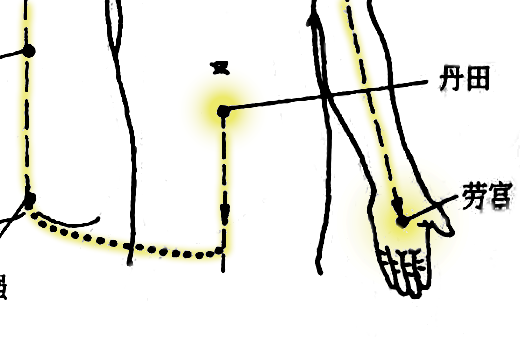
The following is my translation of an article (along with the original in Chinese) written by Gengmenpai’s 耿门派 Dr Wu, the successor to Dr Jiang Feng. The article begins by discussing some general points about qigong/neigong practice, the meridians and orbits, and then continues with a brief discussion of waiqi emission (fagong 发功). Notable are the alternate routes for waiqi emission that are outlined along with schematic images, including two routes that are different from the basic one that beginners usually start with when first learning to practice fagong. Written content of this nature from one of the high-level Gengmenpai practitioners is very rare, making this something worthy of translation…
-
My Experience Practicing Waiqi 外气 Emission (Fagong 发功)
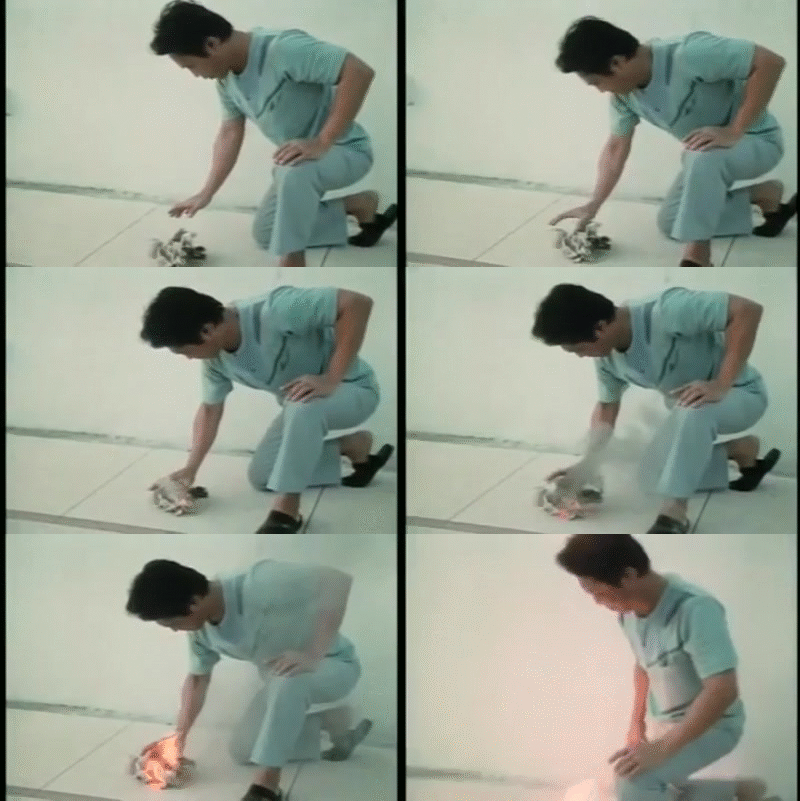
In lineages such as the Shaolin Gengmenpai 耿门派, many if not most of the advanced practitioners practice a style of Classical Chinese Medicine that involves various forms of qi emission. Most who have visited them for treatment have experienced their electric-like “waiqi” 外气 (external qi) emission, the experience of which feels like you are being zapped by a fairly powerful electrical current. If, for example, you receive this qi emission (faqi 发气) up one of your arms, it is powerful enough to cause all of the muscles in your arm to involuntarily contract, until the person emitting pulls the qi back in and “turns it off.” In practicing the neigong…
-
What is the difference between Qigong 气功, Neigong 内功, and Neidan 内丹?
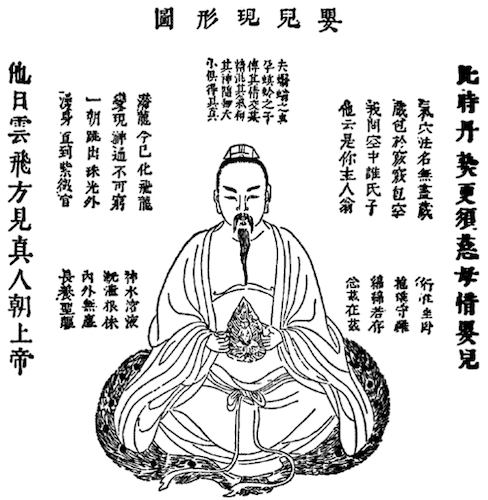
Summary: We should be wary of narrow definitions of these terms applied broadly as they can refer to many things and can often overlap or be interchangeable in many contexts. “Neigong” and “Qigong” are basically synonymous and are umbrella terms for a wide range of energetic practices that cultivate the “post-heaven” qi 氣 (houtian zhi qi 后天之气) of the body. From what I have seen, these two terms seem to be treated synonymously in many, if not most, Chinese internal arts circles, although Western internal arts circles are increasingly distinguishing them in specific ways. Neidan differs in that it is a specific (yet still vast) genre of practice that seeks to…
-
Understanding Qi
Summary: Qi is the fundamental stuff of existence according to classical Chinese thought. It is the living, flowing, transforming substratum of existence encompassing everything from matter to energy to consciousness and more. It needs to be understood within the context of classical Chinese thought and should not be cut-and-pasted out from its native philosophical system into other systems of thought lest it simply become some sort of misunderstood “magical energy.” The Three Treasures (Jing, Qi, and Shen) are important concepts for understanding the body in relation to Chinese internal arts practices. While they are all ultimately just Qi (and the whole of the human body-mind is ultimately also just Qi),…
-
Prepare for Winter in the Summer
There is a saying in Chinese medicine: winter diseases are best treated in the summer “dong bing xia zhi” 冬病夏治. Traditional Chinese health practices are attentive to the interconnections between humans and the cycles of nature. Here, the notion is that disharmonies which tend to present themselves in the winter, especially in those who have a tendency towards yang deficiency, are best dealt with by taking preventative measures in the late summer, particularly a special period referred to as San Fu Tian 三伏天 (sometimes translated as the “dog days of summer”). San Fu Tian, which occurs in three phases that span around forty days, is the optimum time for growth…
-
What is Yijinjing 易筋經?
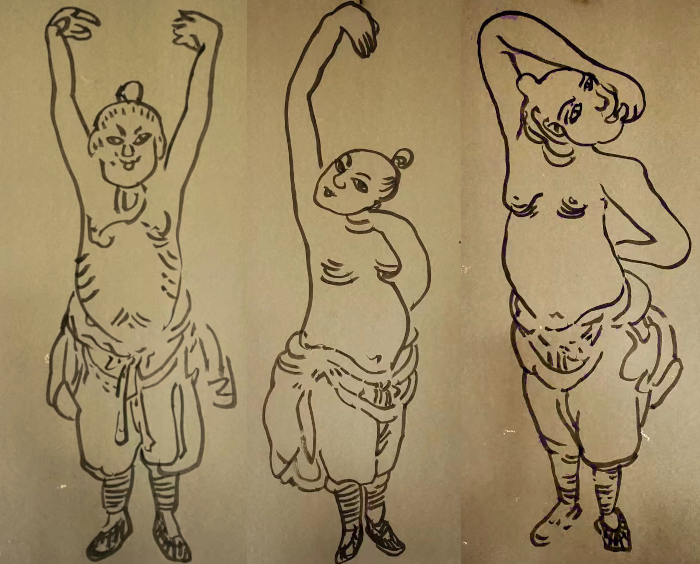
Yijinjing 易筋经/易筋經 refers to a collection of methods of powerful Chinese neigong 内功 (“internal skill”). Legend has it that it originated from the Indian monk Bodhidharma (Damo 达摩) who came to China and founded Chan 禅 Buddhism (the form of Buddhism which later became known as Zen in Japan) at the Shaolin Temple. In fact, neigong containing the Yijinjing principles and signature movements can be found throughout China within various traditions. The word Yijinjing consists of three Chinese characters: Yi 易: The character’s two components are 日 “sun” and 勿 “not.” The sun represents constancy, it was the most constant thing in one’s visible surroundings. Putting the two characters together,…
-
My First Journey to the Yellow Mountains 黄山
It was 2014 and it was the first time I ever set foot in China. I was lying in a small hotel room in the Hongqiao airport hotel, resting after a series of flights that had seemed endless. I turned on the TV in the room and saw that the movie Painted Skin (Hua Pi 畫皮) was playing, a movie in which Zhou Xun plays a seductive, shape-shifting fox spirit who relies on a steady supply of fresh human hearts to maintain her youthful appearance. Despite the movie playing, I kept thinking about what lay ahead in the coming days. The next day, I would take a flight down to…
-
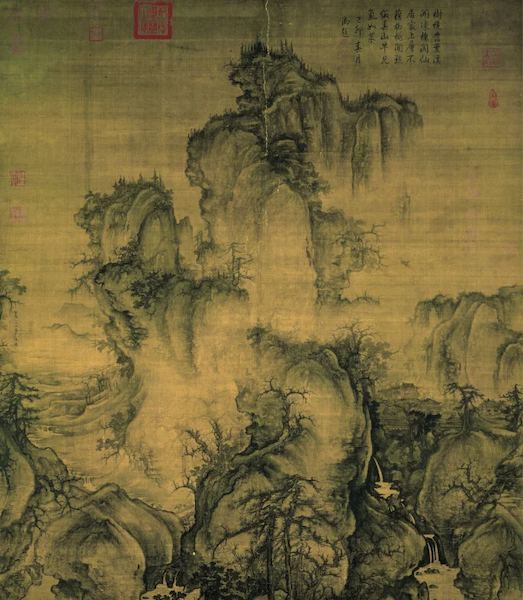
Mountains and Rivers of the Human Body
The Chinese saw the universe as unfolding from the Unity of the Dao into the multiplicity of diverse processes and objects that we see around us. This unfolding was understood and expressed through various organizing principles including Yin and Yang, the Five Phases (“Five Elements”), and the trigrams and hexagrams of the Yijing, among others. These universal patterns were seen as operating throughout nature, at all scales, so the idea of macrocosmic and microcosmic correlation was natural. As above, so below. This so-called “correlative cosmology” lead way to the idea that the human body is a miniature cosmos, because indeed, the patterns of natural expression found in the universe at…